Gungnir – Pino Noir Pyment
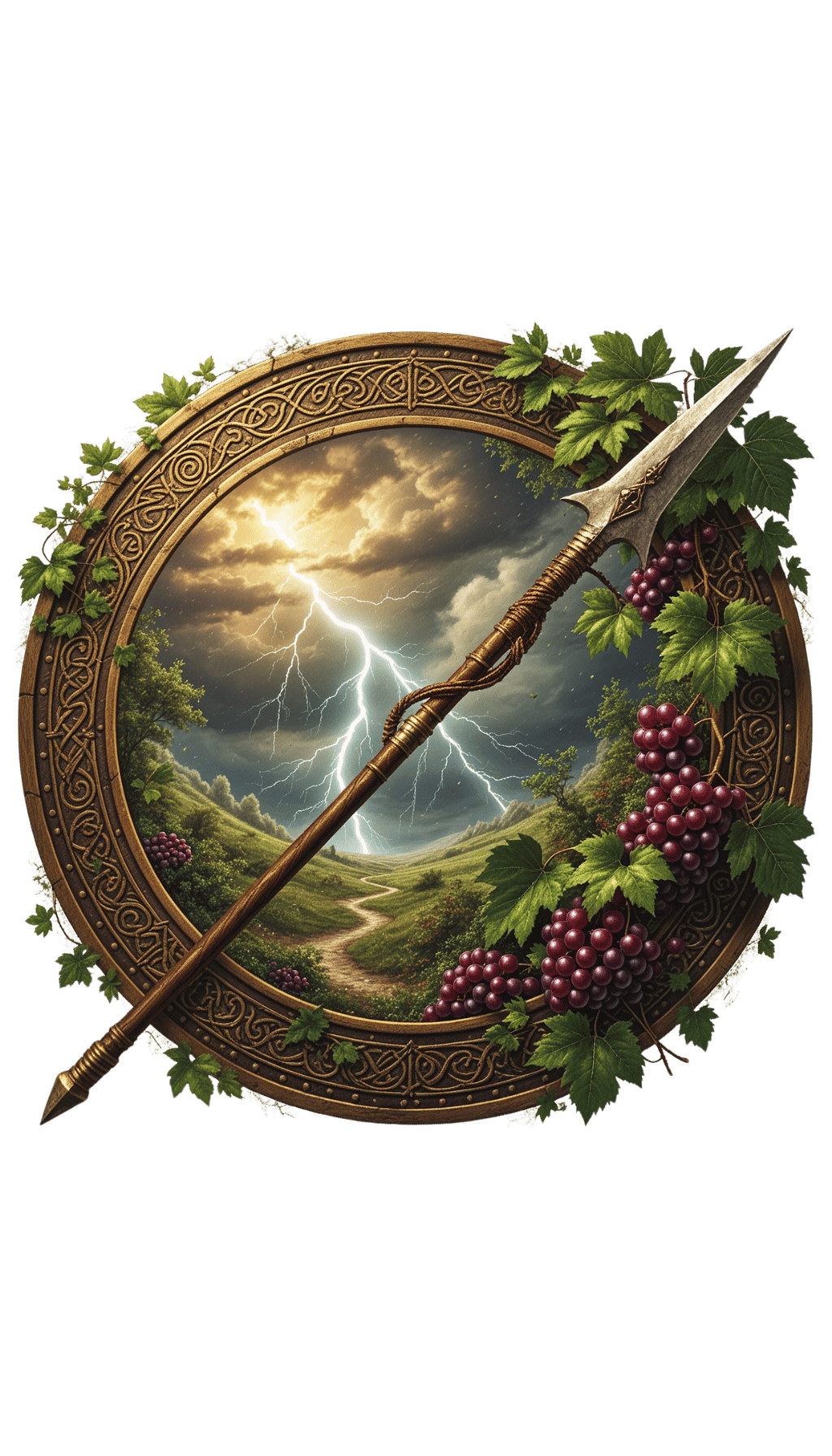
Gungnir is a bold and enchanting Pinot Noir Pyment inspired by the legendary spear of Odin, the Allfather of Norse mythology. Crafted from premium Pinot Noir grapes and fragrant wildflower honey, this sparkling mead combines the richness of wine grapes with the timeless sweetness of honey to create a drink worthy of the gods.
At 7.5% ABV and carbonated, Gungnir is made in the tradition of Austrian Sturm, celebrating the vibrant, youthful character of partially fermented grape must. The result is a luscious and sweet beverage bursting with fresh grape character, layered with floral honey notes and a lively effervescence that dances across the palate. Each sip delivers a harmonious balance of ripe Pinot Noir fruit, rich nectar-like sweetness, and refreshing sparkle.
Like its namesake, a spear said to never miss its mark, Gungnir strikes with precision and purpose, offering a memorable drinking experience that is both approachable and complex. Its rich grape and honey flavors make it perfect for sharing at celebrations, pairing with desserts, or simply enjoying as a unique expression of meadmaking tradition. Sweet, vibrant, and irresistibly drinkable, Gungnir embodies the meeting of ancient legend and modern craft.
Gungnir: The Spear of Odin
Gungnir, whose name is commonly interpreted as“the Swaying One” or“the Rocking One,” is the legendary spear of Odin, the Allfather of Norse mythology. More than a weapon, Gungnir represents Odin’s authority over warfare, sacrifice, wisdom, and fate. Just as Thor is immediately recognized by his hammer, Mjölnir, Odin is frequently portrayed carrying his spear as a sign of divine command.
The Forging of Gungnir
The story of Gungnir’s creation appears in Skáldskaparmál, a section of the medieval Prose Edda. Its origin begins not with Odin, but with the mischief of Loki.
After Loki cut off the golden hair of Sif, Thor’s wife, he was forced to make amends. Loki traveled to the realm of the master smiths known as the Sons of Ivaldi and persuaded them to fashion new hair for Sif from gold. While completing this task, the smiths also created two additional treasures: Skíðblaðnir, a marvelous ship associated with the god Freyr, and Gungnir, the spear that was presented to Odin.
Gungnir was said to be so perfectly balanced that it would strike its intended target regardless of the strength or skill of the person wielding it. Norse rune lore also describes runes carved into the spear’s point, reinforcing its connection to magical knowledge and Odin’s command of the runes.
The creation of these treasures led Loki into a wager with another pair of dwarven craftsmen. That contest produced additional divine objects, most famously Mjölnir, Thor’s hammer. In this way, Loki’s reckless act ultimately resulted in several of the most important treasures possessed by the Norse gods.
Gungnir and the Beginning of War
Gungnir’s importance extends beyond its craftsmanship. In the Poetic Edda poem Völuspá, Odin casts a spear over the opposing host at the beginning of the war between the Æsir and Vanir, the two principal groups of Norse gods. The poem does not explicitly name that spear as Gungnir, so it is best understood as a traditional association rather than a certainty stated by the text.
The act of casting a spear over an enemy carried powerful ritual meaning. It symbolically placed the coming battle under Odin’s authority and dedicated the conflict and its fallen warriors to him. Odin was not merely a god who fought in wars. He was associated with the battle’s outcome, the selection of the slain, and the fate awaiting warriors after death.
This gives Gungnir a darker and deeper meaning than that of an ordinary heroic weapon. It is not simply an instrument of strength. Its flight represents a decision that cannot be recalled and a fate that cannot easily be escaped. Once the spear is cast, the course of events has been set in motion.
The Spear, Sacrifice, and Wisdom
Gungnir is also closely associated with Odin’s relentless pursuit of knowledge. In Hávamál, Odin describes hanging for nine nights upon a wind-swept tree, wounded by a spear and sacrificed to himself. Through this ordeal, he gains knowledge of the runes.
The poem does not specifically identify the spear used in this sacrifice as Gungnir. Nevertheless, later tradition and modern interpretations frequently connect the unnamed spear with Odin’s personal weapon. The association is thematically fitting, but it should not be confused with an explicit statement from the surviving poem.
This episode reveals something essential about Odin. He does not gain wisdom without cost. Knowledge requires pain, endurance, and sacrifice. The spear therefore symbolizes more than conquest. It also represents the piercing insight that comes from suffering and the willingness to surrender something valuable in exchange for greater understanding.
Gungnir at Ragnarök
Gungnir remains with Odin until the final battle of Ragnarök. In the Prose Edda, Odin rides at the front of the Einherjar, the chosen warriors gathered in Valhalla, wearing a golden helmet and mail coat and carrying Gungnir. He advances against Fenrir, the monstrous wolf destined to kill him.
This final appearance is especially significant. Gungnir is a weapon renowned for its extraordinary accuracy, yet even it cannot release Odin from his foretold fate. Norse mythology does not usually present fate as a problem that greater power can overcome. Gods and monsters alike move toward destinies they may understand but cannot ultimately prevent.
Odin’s decision to carry Gungnir into his final confrontation therefore symbolizes courage in the face of certainty. The spear does not guarantee his survival. Instead, it demonstrates his willingness to meet his destiny fully armed and without retreat.